
Dinwiddie Projected and Actual Release
A projected or anticipated release date is a calculation based on facts known at the time. It may guide planning, but it does not show that a person passed through the release door. The actual event is established by the final custody movement, release order or letter, and any record of supervision that began. A date shown before release must therefore remain labeled as projected or anticipated.
Pretrial detention works differently. A person held on a pending Dinwiddie County case has no sentence-based release date because there is no final active sentence to compute. Release can depend on bond, recognizance, later court action, or another hold. Even after a judge orders release, jail staff may still process the order and check for warrants or detainers. A detainer is a request or legal basis for another authority to take or hold the person.
A transfer is also not an actual community release. Leaving the Dinwiddie County Lockup may mean transport to MRRJ. Leaving MRRJ may mean VADOC, another jail, court, federal custody, medical custody, or the community. Name the receiving authority whenever the record provides one.
Find Dinwiddie Projected Release Dates
The custody type determines the search. The VADOC Inmate and Supervisee Locator is the public route for a state-responsible prisoner. Search by DOC ID when possible. A name search requires first and last name, with optional location, race, gender, and age-range filters. Compare several identifiers. VADOC says its data updates daily and may be inaccurate or out of date.
- Identify whether the Dinwiddie case is pretrial, a local sentence, or a state-responsible sentence.
- For state custody, search the VADOC locator by DOC ID or name and read the exact release-date label shown on the live record.
- For an MRRJ sentence, contact MRRJ and ask which local or state authority computes time for that sentence.
- Compare the court commitment and sentencing order, including active time, suspended time, jail credit, and concurrent or consecutive terms.
- If the result conflicts with the sentence record, request the time-computation record from the responsible authority.
- After the date passes, obtain the release letter, order, or final movement entry to confirm what occurred.
The VADOC locator capture for Dinwiddie shows a privacy-safe result with status and release-date context.
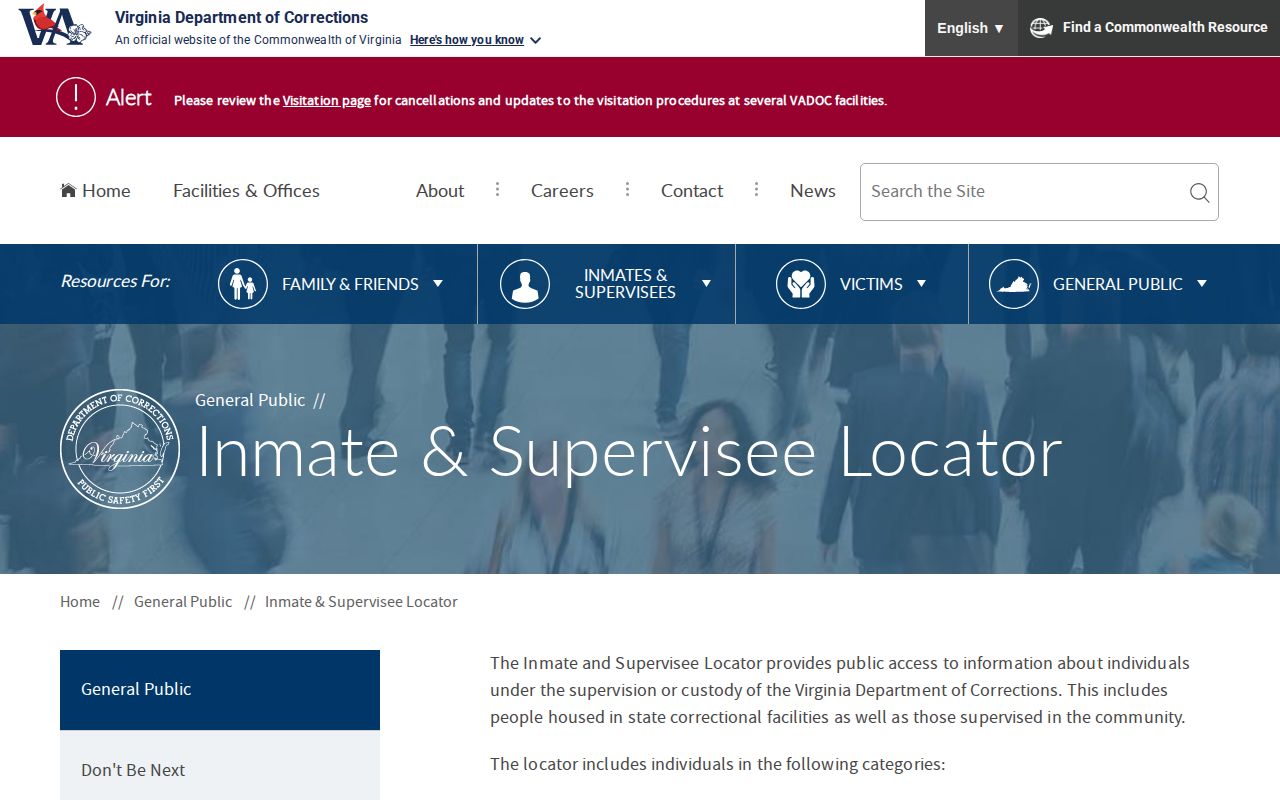
The displayed label should be copied exactly from the live record because “anticipated,” “projected,” and “actual” are not interchangeable.
Note: A daily locator update is not real-time release processing, so confirm a date change with the authority that computes the sentence.
Dinwiddie Jail and VADOC Calculations
Not every Dinwiddie County sentence is calculated by VADOC. The state explains that local or state responsibility depends on the sentence. VADOC calculates active earned-sentence-credit sentences longer than twelve months. A shorter local sentence can remain the responsibility of the jail or another local calculating authority. Ask MRRJ who owns the computation rather than sending every date question to Richmond.
Several records must agree. The court commitment states the sentence and whether terms run together or one after another. Jail records show time served before VADOC received the person. VADOC applies the governing credit system, earning class, disciplinary history, and later legal events. An error in jail credit, sentence structure, or identity can change the output, which is why the underlying computation record matters more than an informal estimate.
The VADOC time-computation page identifies the responsible agency and the factors used.
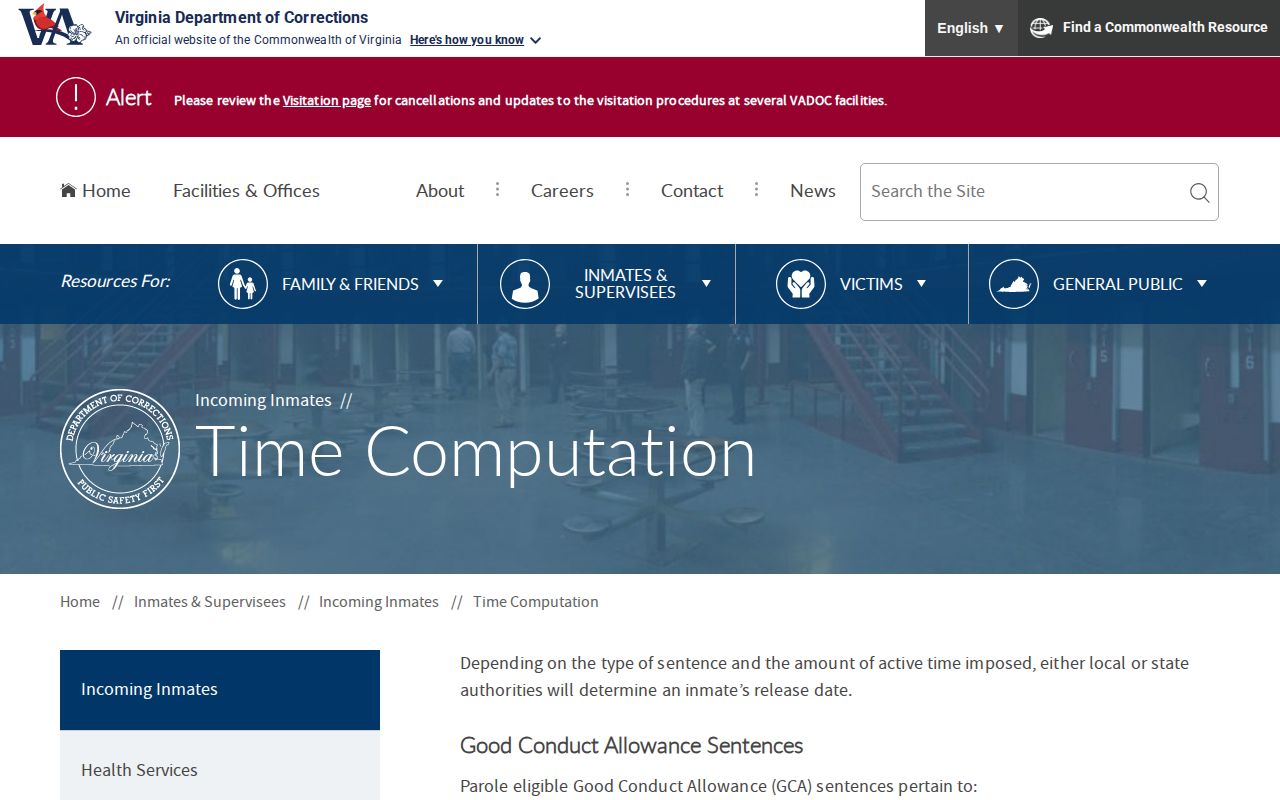
The official source supports routing local and state sentences to the right custodian before asking for a corrected projected date.
VADOC Court and Legal CorrespondencePO Box 26963
Richmond, VA 23261
804-674-3000
docmail@vadoc.virginia.gov
Virginia Earned Credits for Dinwiddie
Earned sentence credits can reduce the time a qualifying person must serve, but eligibility and the rate come from statute. Virginia Code § 53.1-202.2 generally applies the system to qualifying felony offenses committed on or after January 1, 1995, with sentences in a state or local correctional facility after final conviction. One credit equals one day deducted. The official Code page can contain current and future versions, so the version in force on the date of the calculation controls.
Section 53.1-202.3 sets earning levels and caps. Depending on eligibility, classification, conduct, programming, and statutory limits, the levels can provide fifteen, seven and one-half, three and one-half, or zero days of credit per thirty days served. Specified serious offenses are capped at four and one-half days per thirty days. Older offense and sentence categories may fall under older good-conduct allowance rules, with exclusions in § 53.1-199.
- Jail credit
- Credit for qualifying time held before the state receives or computes the sentence.
- Earned sentence credit
- A statutory day-for-day deduction earned at the rate that applies to the offense and classification.
- Concurrent sentences
- Terms served at the same time, subject to the commitment and computation.
- Consecutive sentences
- Terms served one after another.
- Active time
- The part of a sentence ordered to be served, apart from suspended time.
The credit rate is not selected by the person searching the record. It comes from the offense, legal effective date, exclusions, and agency classification. A change in conduct or classification can alter future earning and move the estimate.
Why 85 Percent Is Not Universal
The phrase “serve 85 percent” is common in Virginia, but it is not a universal Dinwiddie County release-date rule. The four-and-one-half-day cap for specified serious offenses produces the familiar approximation: thirty days served plus four and one-half days of credit means about eighty-five percent of the total is served. That math does not place every offense in the same credit level.
Other eligible offenses may earn at the fifteen, seven-and-one-half, three-and-one-half, or zero-credit level per thirty days. Statutory exclusions can block credits, and the person’s classification, programming, conduct, and governing version of law all matter. A correct estimate therefore begins with the offense date and statute, then moves to the agency calculation. Starting with a blanket percentage can create a false release date.
Virginia’s parole rules are separate. Ordinary discretionary parole was abolished for most felony offenses committed on or after January 1, 1995, while defined eligible groups remain. Parole eligibility and earned sentence credits should not be blended into one formula. A Board decision can affect release in an eligible case, but it does not rewrite the credit statute.
Note: Use the credit level and law tied to the offense, not a universal percentage, when checking a Dinwiddie release estimate.
Dinwiddie Release Date Changes
A projected date can move forward or back as the official computation changes. Some factors are part of the original sentence, such as jail credit and whether terms are concurrent or consecutive. Others arise later, including a disciplinary event, new sentence, revocation, appeal, or corrected court order. A detainer may not change the mathematical end of one sentence but can prevent community release by sending the person to another authority.
| Factor | Possible effect | Record to check |
|---|---|---|
| Pre-sentence jail time | Qualifying credit can reduce time left | Jail record and time computation |
| Concurrent or consecutive terms | Changes how multiple sentences combine | Sentencing and commitment orders |
| Credit level or discipline | Changes earned-credit pace or available credit | VADOC computation and classification record |
| New sentence or revocation | Can add active time or return a supervisee to custody | Later court or Board order |
| Detainer or hold | May send the person to another authority at release | Custody-movement and receiving-agency record |
| Appeal, clemency, or correction | May change the legal sentence or computed date | Final order and corrected computation |
Escape time, administrative correction, parole action, and other legal events can also affect the result. Ask for the calculation as of a stated date. That makes it easier to understand why a later result differs rather than treating either screen as a permanent promise.
Confirm Dinwiddie Actual Release
The projected date answers a planning question. The release packet answers what happened. VADOC says release occurs by 11:59 p.m. on the release date, weather permitting. That is an outer limit, not a routine hour or pickup appointment. MRRJ has not published a standard daily release time, weekend rule, release gate, or waiting policy. Call the responsible facility before travel.
VADOC release materials may include a notification-of-release letter, Order of Release, Conditions of Probation, or Conditions of Parole with signatures and dates where applicable. These documents distinguish release into the community under supervision from final discharge. For a local MRRJ sentence, ask for the existing release or custody-movement entry with date, time, type, and destination.
The VADOC facility-release page captured for Dinwiddie explains the letter, documents, and release-day limit.
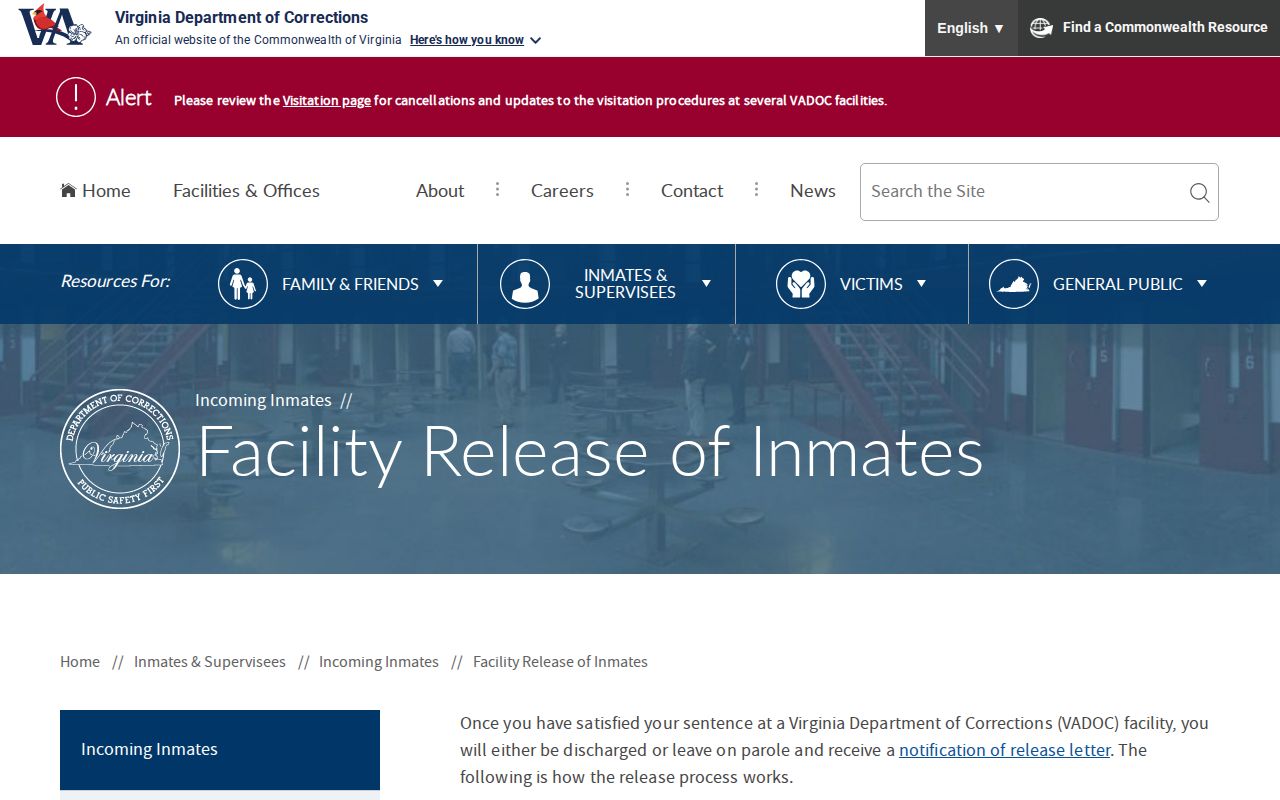
The release papers provide stronger proof of the completed event than an anticipated date that appeared earlier in the locator.
Dinwiddie Release Supervision Handoff
Release from a VADOC institution may begin parole or probation. A result assigned to Petersburg District 7 means the person is in the community under active VADOC supervision, not still inside a prison and not fully discharged. Confirm the office because assignments can change and locator data can lag.
For a pending MRRJ event, Virginia VINELink can send a local release or transfer alert. State-prison notification now uses NAAVI for eligible victims and immediate family. The systems may overlap during an MRRJ-to-VADOC transfer, and a local “released or transferred” notice can mark the start of state custody. Registration and interpretation details are covered in the Dinwiddie VINELink Release Check.
If a projected date, alert, and final record disagree, preserve each source and retrieval time. Ask the calculating authority to explain the computation and the releasing authority to confirm the physical movement. The broader Dinwiddie County released inmate search routes local, regional, state, federal, and court records by custody type.